
AI has made marketing faster.
That may be the least interesting thing it has done.
Almost any marketer can now create 20 headlines before breakfast, summarise a two-hour research call in seconds, generate an image without a designer or ask an LLM to build a campaign plan.
Useful? Absolutely.
An advantage? Not for long.
Because when everybody has access to roughly the same intelligence, access to intelligence stops being the differentiator.
The real AI marketing advantage is moving somewhere less visible. Into the systems behind the work.
The marketers pulling ahead are beginning to build AI systems that can sense what customers want, simulate what might happen next, act inside a live customer journey and learn from the outcome.
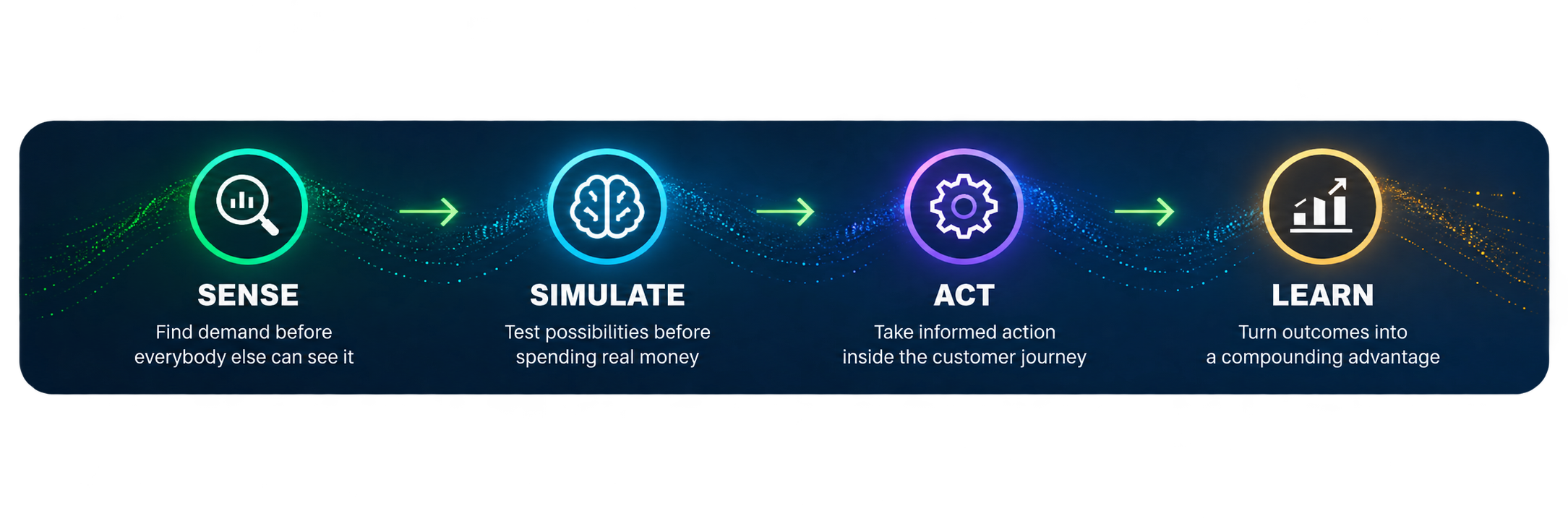
Not another prompt. A loop.
And sitting in the middle are the two things competitors cannot download from an app store: proprietary context and permission to act.
These advanced AI marketing use cases show where that advantage is beginning to emerge.
What are advanced AI marketing use cases?
The most advanced AI marketing use cases go beyond generating content or automating individual tasks. They connect customer and market signals with simulation, permissioned action and measured outcomes, allowing marketing systems to improve decisions over time.
In other words, most teams are still asking AI to produce things. The frontier is teaching AI to decide things.
15 advanced AI marketing use cases at a glance
| Advanced AI marketing use cases | Stage | Readiness | First KPI to watch |
|---|---|---|---|
| Prompt-market intelligence | Sense | Now | Decision-stage prompt coverage |
| Share-of-answer observability | Sense / Learn | Now | Accurate brand mention rate |
| Agent-ready product and service feeds | Act | Now | Feed completeness |
| Conversational brand concierge | Act | Now | Resolution / qualified conversion |
| Adaptive conversational offers | Act | Now | Incremental margin |
| Autonomous one-to-one decisioning | Act / Learn | Now | Incremental value |
| Synthetic customer panels | Simulate | Emerging | Correlation with human research |
| Customer digital twins | Simulate | Emerging | Calibration accuracy |
| Emotion-led customer maps | Sense | Now | Human/model agreement |
| Closed-loop creative evolution | Act / Learn | Now | Incremental creative performance |
| Creator-community affinity graphs | Sense | Emerging | Qualified community reach |
| Rights-aware content knowledge graphs | Act | Now | Approved asset reuse |
| Privacy-safe partner intelligence | Sense / Learn | Now | Incremental model lift |
| Causal budget copilots | Simulate / Learn | Now | Incremental profit |
| Permissioned campaign operations agents | Act / Learn | Now | Time from problem to resolution |
Find demand before everybody else can see it
Move beyond the obvious signal and understand the language, emotion and intent sitting underneath customer behaviour.
Marketing has always wanted to know what customers are thinking.
The trouble is, customers rarely type their entire problem into a search box.
They might search for “CRM software”.
But when they talk to an AI assistant they can reveal the real problem:
“What CRM would work for a 30-person B2B SaaS company with a small sales team, HubSpot experience and no dedicated RevOps person?”
One is a keyword.
The other is a buying brief.
That difference matters.
Prompt-market intelligence
Prompt-market intelligence treats conversational questions as market research, not search traffic.
Rather than measuring only keyword volumes, marketers can build libraries of the questions, comparisons, constraints and follow-up prompts customers use while making decisions.
Google describes AI Mode as using a query fan-out technique that breaks complex questions into subtopics, while platforms such as Adobe Brand Visibility are developing tools for examining prompts and brand visibility across AI experiences.
The opportunity isn’t simply finding another keyword.
It is discovering the shape of the decision.
Then ask an uncomfortable question:
How much of the actual decision does our content answer?
KPI: decision-stage prompt coverageMeasure qualified visits, assisted conversions and the number of important decision-stage questions you cover.
The danger is obvious. Ask AI to invent your customers’ questions and you may simply create an elegant map of the model’s own assumptions.
Real language first. Synthetic expansion second.
Emotion-led voice-of-customer maps
Traditional text analytics tells you what customers discuss.
AI increasingly allows marketers to investigate how people feel while discussing it.
That distinction is bigger than it sounds.
Two customers may both mention price.
One means: “This seems expensive.”
Another means: “This feels risky.”
Same topic. Different marketing problem.
Recent research has shown that language models can classify a wide range of emotional and relationship constructs across open-ended customer language, although accuracy must still be validated for individual brands, populations and cultures.
Done carefully, marketing teams could map emotions such as confidence, anxiety, trust and commitment across reviews, calls, surveys and conversations.
Then change messaging according to the emotional obstacle rather than the superficial topic.
KPI: human/model agreementBut emotion inference should remain exactly that: inference.
It should inform aggregated customer understanding, not become an excuse to target individuals because an algorithm thinks they are vulnerable.
Spend imaginary money before spending real money
Use AI as a rehearsal room for expensive decisions, while keeping human research as the source of evidence.
Market research is expensive for a good reason.
People are complicated.
Unfortunately, AI has noticed.
And it can now imitate some of that complexity surprisingly well.
The temptation is to conclude that synthetic customers can replace real ones.
They can’t.
The more interesting opportunity is different.
AI can make it cheaper to be wrong before you ask humans whether you are right.
Synthetic customer panels
Imagine developing ten campaign propositions.
Today you might reduce them internally to three, then put those three into research.
A synthetic panel offers another layer.
Ground models in existing customer research, ask hundreds of simulated respondents to react to the ten propositions, identify contradictions and uncertain areas, and use the result to decide what deserves expensive human investigation.
Research published in 2025 found strong aggregate similarity between synthetic and human purchase-intent responses under a specific methodology.
Other studies found meaningful differences in language, opinion diversity, subgroup variance and bias.
Which is exactly why the most intelligent application isn’t:
“AI told us customers love it.”
It is:
“AI helped us find the questions worth asking customers.”
Synthetic customers should create hypotheses. Human customers should create evidence.
Customer digital twins
A synthetic respondent answers a question.
A customer digital twin tries to model a journey.
- What might happen if the price rises?
- What happens if onboarding changes?
- What if a support failure occurs halfway through the relationship?
- What happens if we recommend product B rather than product A?
Adobe is already commercialising simulation using customer-grounded synthetic audiences, while academic research into digital twins has shown promising behaviour prediction in carefully bounded datasets.
This could give marketers something they have rarely had:
A cheap rehearsal room for expensive decisions.
But digital twins have a psychological danger.
The more detailed the simulated customer becomes, the more human they feel.
And plausibility can masquerade as truth.
Use the twin to decide what to investigate. Not to pretend the future has already happened.
Stop waiting for customers to reach the landing page
AI is moving from helping marketers create experiences to participating directly in the buying journey.
Perhaps the biggest shift in AI marketing is happening quietly.
The customer journey is changing actors.
Sometimes the person making the first decision may not be a person at all.
AI assistants are beginning to discover products, compare options and conduct parts of transactions for users.
Marketing has spent decades optimising pages for human visitors.
It may now need to optimise information for machine customers too.
Agent-ready product and service feeds
For an AI agent, your beautiful homepage may be less useful than a boring, perfectly maintained data feed.
Price. Availability. Compatibility. Terms. Variants. Delivery. Returns. Provenance. Restrictions.
These facts become marketing.
OpenAI has published product-feed specifications to support product discovery, while Google’s Universal Commerce Protocol is designed to support AI-mediated commerce and post-purchase interactions.
This changes optimisation.
The winning product may not simply be the one with the most persuasive page.
It may be the one an agent can understand with the greatest confidence.
Measure completeness, freshness, rejection rates and recommendation eligibility.
Because there is something worse than being invisible to an AI buyer.
Being confidently misrepresented by one.
Conversational journeys and the brand concierge
Websites are built like filing cabinets.
Click. Read. Go back. Click something else. Read.
Find the contact form. Fill in six fields. Wait.
We have normalised this largely because websites couldn’t talk back.
Now they can.
Adobe, Salesforce and Google are developing conversational commercial agents capable of answering questions, recommending products or resources and moving customers further through buying journeys.
A good brand concierge should not simply bolt ChatGPT onto your homepage.
It should know what it knows.
Know what it doesn’t.
Use approved brand evidence.
Understand the current conversation.
And hand that context to a human when the machine reaches its limits.
The chat box is not the innovation. Removing unnecessary steps from the decision is.
Adaptive offers inside live conversations
Personalisation has traditionally meant deciding what somebody might want before they arrive.
Conversational AI creates another possibility.
Wait until they tell you.
A customer may not need 10% off.
They may need faster delivery. More storage. A different bundle. A longer contract. Better support.
Google’s emerging agentic-commerce capabilities include conversational product attributes, bundles and offers, while payment providers are building infrastructure for transactions within customer-defined limits.
That means offers could eventually adapt to the reason behind hesitation.
Measure incremental conversion and contribution margin.
Because an AI capable of increasing conversion by giving everything away has not discovered marketing genius.
It has discovered discounts.
Autonomous one-to-one decisioning
Segmentation is one of marketing’s favourite ways of pretending millions of people come in twelve convenient varieties.
AI gives us an alternative.
Decisioning systems can increasingly choose combinations of message, channel, timing, offer and frequency for an individual context and learn from the response.
Braze is applying reinforcement-learning approaches to this problem, while Salesforce is developing agent-based marketing orchestration.
The opportunity is enormous because the valuable asset isn’t the generated message.
It’s the decision policy learned from thousands of outcomes.
Measure incremental revenue, retention, unsubscribes, complaints and long-term value.
The machine will optimise whatever you reward.
So be very careful what you teach it to want.
Make every campaign improve the next one
Generation creates more output. Learning turns repeated outcomes into an advantage competitors cannot instantly copy.
Generative AI gave marketing more output.
That created another problem.
More output.
The next advantage won’t come from generating 500 assets instead of 50.
It will come from remembering why asset 17 worked.
Closed-loop creative evolution
Imagine every campaign leaving behind something more useful than a performance report.
A memory.
- Which argument worked?
- Which proof?
- Which visual construction?
- Which audience?
- Which channel?
- Which elements fatigued quickly?
- Which damaged brand distinctiveness despite generating clicks?
Google is expanding multimodal creation and testing tools, while research into human-AI creative collaboration suggests structured AI assistance can improve selection and creative outcomes.
The smart system therefore isn’t:
generate → publish → forget.
It is:
create → test → explain → learn → create better.
Measure business response, creative fatigue, reuse of validated ideas and brand compliance.
Otherwise generative AI may produce more creative while slowly making everybody look the same.
For a practical example of the human judgement required around AI-generated creative, read AI Marketing Needs Human Taste, Not More Tools .
Creator-community affinity graphs
Influencer marketing loves numbers.
Followers. Views. Engagement.
But communities rarely form around demographic labels.
They form around ideas. Problems. Language. Beliefs.
AI embeddings can help marketers map creators and their audiences semantically, exposing clusters of conversation that may be difficult to discover through conventional category filters.
Google has described using AI to understand creator content and connect brands with relevant creator communities.
The more interesting opportunity is early detection.
Because two creators can look statistically adjacent while existing on opposite sides of an internet war.
Meaning needs context.
Rights-aware content knowledge graphs
Most large companies don’t have a content shortage.
They have a content archaeology problem.
Somewhere inside SharePoint, Google Drive, a DAM, six agency folders and somebody’s desktop is exactly the statistic, quote, proof point or case study somebody needs.
Unfortunately nobody can find it.
And even if they do, nobody is quite sure whether they can still use it.
Rights-aware knowledge graphs can connect content with meaning, claims, sources, audiences, ownership, usage rights, expiry dates and performance.
PwC has described knowledge-graph approaches to AI content personalisation, while Adobe has reported operational improvements among companies introducing more connected content infrastructure.
This matters because AI retrieval is only as trustworthy as what it retrieves.
Give an agent a perfectly organised library of outdated claims and it will become wonderfully efficient at being wrong.
KPI: approved asset reuseThe real advantage is trusted reuse.
Privacy, causality and controlled autonomy
The least glamorous layer may become the hardest advantage to copy.
This is where things become less glamorous.
And more valuable.
Anyone can access a model.
Far fewer organisations can connect proprietary data, collaborate safely with partners, prove causal impact and allow AI to act inside controlled permissions.
That is the hidden engineering beneath modern marketing advantage.
Privacy-safe partner intelligence
The decline of third-party identifiers doesn’t necessarily mean the decline of partner intelligence.
It changes the rules.
Clean rooms and privacy-enhancing technologies increasingly allow retailers, publishers, platforms and brands to train or evaluate models collaboratively without exchanging raw customer-level datasets.
AWS, for example, supports privacy-enhanced synthetic dataset creation inside Clean Rooms, while researchers have demonstrated privacy-preserving approaches to conversion modelling.
This could improve measurement, conversion models and audience understanding.
But the word “synthetic” is dangerous when treated as a synonym for “safe”.
Synthetic data can still create privacy risks, which is why privacy testing belongs before marketing testing.
Privacy is not the obstacle to advanced AI marketing.
Increasingly, privacy engineering is part of the advanced capability.
Causal budget copilots
Attribution asks:
What received credit?
A causal budget copilot asks a more valuable question:
Where should the next pound go?
Google’s Meridian and Meta’s Robyn are pushing marketing-mix modelling further by combining aggregate data, modelling techniques and budget optimisation.
Connect these techniques to a conversational copilot and marketers can begin interrogating budget scenarios rather than merely reading reports.
- What happens if paid search rises 15%?
- Where are diminishing returns appearing?
- What does the model think will happen if £100,000 moves from channel A to B?
- How uncertain is that answer?
Measure incremental profit.
Not how persuasive the chart looked.
Permissioned campaign operations agents
There is a large gap between an AI that notices something is wrong and one that is allowed to fix it.
That gap may become one of the most productive places in marketing.
Imagine an agent noticing that campaign performance has collapsed.
It checks tracking. Examines spend. Looks for rejected ads. Checks landing pages. Finds a policy issue. Drafts the correction.
Then asks for approval.
That is far more valuable than another red arrow on a dashboard.
But permissions change everything.
Measure time from anomaly to resolution and hours returned to higher-value work.
Autonomy should not be granted because the AI sounds intelligent. It should be earned because the system repeatedly proves trustworthy.
The AI marketing secret isn’t AI
There is a pattern running through all 15 of these advanced AI marketing use cases.
And it is not the model.
The model is increasingly the commodity.
The advantage comes from what surrounds it:
- Your customer evidence
- Your proprietary context
- Your integrations
- Your experiments
- Your commercial constraints
- Your permissions
- Your learning history
That is why buying another AI marketing tool can feel productive while producing very little lasting advantage.
A competitor can buy the same tool tomorrow.
They cannot instantly recreate two years of carefully governed decisions and outcomes.
That is the moat.
Not artificial intelligence.
Organisational intelligence.
How to start without creating an AI monster
The answer is not to give an autonomous marketing agent your CRM password, advertising account and corporate credit card on Monday morning.
Build permissions in stages.
Automation should expand at the speed of evidence, not enthusiasm.
Choose one high-value marketing decision.
One useful data source.
One measurable outcome.
One holdout.
One human approval point.
Then run the smallest experiment capable of proving that something genuinely changed.
Because the companies that win with AI marketing won’t necessarily be the companies that automate the most.
They will be the companies whose systems learn the fastest without losing control.
And that is a much harder advantage to copy.
Selected primary evidence
The examples in this article draw on emerging platform capabilities, primary documentation and current research. Useful source material includes:
- Google: AI Mode and query fan-out
- Adobe Brand Visibility
- OpenAI product feed specification
- Google Universal Commerce Protocol
- Adobe Brand Concierge
- Braze: reinforcement learning and AI decisioning
- AWS Clean Rooms: privacy-enhanced synthetic datasets
- Google Meridian marketing mix modelling
- Meta Robyn marketing mix modelling
Frequently asked questions
What are the most advanced AI marketing use cases in 2027?
Advanced AI marketing use cases increasingly combine four capabilities: sensing demand, simulating customer response, acting inside live journeys and learning from outcomes. Examples include prompt-market intelligence, agent-ready product feeds, synthetic customer panels, customer digital twins and autonomous one-to-one decisioning.
What is the difference between AI automation and agentic marketing?
AI automation generally follows a predefined process. Agentic marketing systems can reason over available context, choose between permitted actions and pursue a defined objective. The important distinction is controlled decision-making, not simply whether AI is involved.
Can synthetic customers replace traditional market research?
No. Synthetic customer panels can help screen ideas, identify uncertainty and improve research design, but they should be validated against human research. They are most useful for generating and filtering hypotheses rather than being presented as customer evidence.
How can a small marketing team start using advanced AI?
Start with one decision rather than an AI transformation programme. Choose one useful data source, establish a measurable commercial outcome, maintain a control or holdout where possible, and keep one clear human approval point. Expand only after the pilot proves value.
How should marketers measure GEO or AI answer visibility?
Use a stable set of commercially relevant prompts and repeat the measurement over time. Track accurate mentions, citations, factual errors, supported claims and downstream demand. AI answers are variable, so avoid treating a single observation or composite “GEO score” as market share.
What are the biggest risks of agentic AI in marketing?
The principal risks include excessive system permissions, poor-quality data, hallucinated claims, manipulative personalisation, privacy leakage, discriminatory outcomes and optimisation objectives that reward short-term engagement at the expense of customers or long-term value.
The advantage is the system you build around AI
Most teams can buy the same models. The harder advantage comes from proprietary context, customer evidence, controlled permissions and a learning history that compounds.
If you enjoyed reading about these 15 advanced AI marketing use cases and want more practical frameworks like this, explore The AI Marketer’s Lists & Playbooks. Or read how human judgement becomes more valuable as AI makes production cheaper.